


Although the South African Government’s response to the HIV and TB epidemics in recent years has been lauded internationally, the country faces the long-term prospect of supporting millions of people on antiretrovirals (ARVs) each year. In addition, South Africa needs to invest in addressing the structural drivers of the epidemics and in effective prevention interventions to reduce the hundreds of thousands of new infections each year
South Africa continues to allocate more funding to the HIV response, but there is a growing opportunity cost of shifting funds from other health priorities. This is shown by the increasing proportion of the health budget going to HIV, while the total size of the health budget decreases in real terms.
There is still a large financial gap between funding requirements and available funding for HIV, sexually transmitted infections (STIs) and tuberculosis (TB). The estimated financial gap for the 2014/15 financial year, after taking into account development partner (donor) funds, is approximately R3.6 billion. This financial gap is calculated based on the targets of the National Strategic Plan on HIV, STIs and TB 2012–2016 (NSP), and not the operational targets set by government departments.
“In 2013/14, the annual cost of the required response is R24 billion, and will rise to R32.6 billion in 2016/17.”
Estimates using the National Aids Spending Assessments (NASA), which is a comprehensive resource tracking and review of financing and expenditure for HIV, show an expenditure of R13 billion in 2009/10. Of this, approximately 63% of funds went to ARV treatment. Prevention interventions comprised approximately 23% of the total expenditure, which also includes social protection spending. Other funding went towards research, programme management, human rights and advocacy, capacity building and care and support for orphans and vulnerable children (OVCs).1

Spending on HIV 2009/10
For the 2013/14–2015/16 medium term, the South African Government currently allocates an average of 11.3% of its total government budget towards health spending, which is lower than the Abuja Declaration recommendation that governments should spend 15% of their budget on health. This is also lower than other upper-middle-income countries such as Botswana (17%) and Namibia (13%). However, within the health budget, HIV allocations have grown from 8.8% in 2013/14 to 10% in 2015/16. In comparison, Botswana allocates approximately 36%, and Namibia allocates approximately 25.7%, of its health budget towards HIV.
“Given the changing landscape of increased treatment and prevention needs and diminishing external funding, role players in South Africa need to explore new strategies to ensure that the response is sustained in the future. ”
On April 2012, South Africa launched a new five-year NSP that includes ambitious targets for scaling up treatment, prevention, and care and support services. The NSP states that by 2016, the aim is to reduce new HIV infections by 50%, increase antiretroviral therapy coverage so that 80% of those in need are started on treatment, and reduce the number of new TB infections and TB-related deaths by 50%. The resources required to achieve these objectives were estimated at R133.5 billion over the five-year period. In 2013/14, the annual cost of the required response is R24 billion, rising to R32.6 billion in 2016/17. During this period, South Africa aims to screen between 15 and 25 million people per year for HIV and TB, carry out 4.3 million medical male circumcisions (MMC), increase the number of people on ART from 1.9 million people at the end of 2012, to almost 4.2 million over five years and treat approximately 400,000 adults per year for pulmonary TB.
The resources required to achieve the objectives of South Africa’s NSP for HIV, STIs and TB were estimated to be approximately R27 billion for the 2014/15 financial year. For comparative purposes, TB-related activities have been excluded from the HIV-related components below, but make up R4.2 billion of the total response.
When removing TB from the bundle and looking at HIV only, prevention comprises approximately 25% of the budget and includes activities such as prevention of mother-to-child transmission (PMTCT), STI treatment, HIV Counselling and Testing (HCT), social behavioural change and activities for key populations. While the extent to which HCT contributes to prevention is debatable, HCT comprises the largest proportion of the prevention budget at R3.5 billion. ARV treatment for HIVcomprises 68% of the total cost of the response. Other activities make up R1.59 billion (7%) and include human rights, advocacy and OVC care and support.
Whilst external partners and donors are becoming more focused and strategic in their investments, the general trend in their financing is one of contraction. Given the changing landscape of increased treatment and prevention needs and diminishing external funding, role players in South Africa need to explore new strategies to ensure that the response is sustained in the future.
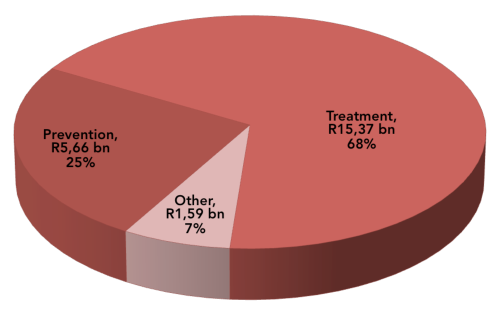
Cost forecast for 2014/15: The resources
required to achieve the objectives of
South Africa’s National Strategic Plan
(NSP) for HIV, STIs and TB were estimated
to be approximately R27 billion for the
2014/15 financial year.
1 OVC generally falls under treatment as it is care and support but for the purposes of this analysis it is excluded from the ARV treatment expenditure for comparative reasons.