SANAC CEO Dr Fareed Abdullah responds to the HSRC National HIV Prevalence, Incidence and Behaviour Survey for 2012 and states that targeted campaigns and programmes that address specific sexual transmission patterns that drive the epidemic are needed.
The 2012 Human Sciences Research Council (HSRC) National HIV Prevalence, Incidence and Behaviour Survey results released in April are cause for serious concern. The survey estimates that there have been 469 000 new HIV infections in South Africa during 2012. As this is a statistical calculation derived from testing 28 997 individuals in communities throughout the country, the authors rightly point out that this number could be anywhere between 381 000 and 557 000, but state that 469 000 is their best estimate.
It is the first time that we have used a new technology, HIV incidence testing, to measure the number of new infections in the country. This, on its own, is a major advance on our previous ability to measure the number of new cases. In the past, we were only able to measure whether an individual was positive or negative (prevalence). With this new incidence testing technology we are able to identify recent infections (incidence), thus giving us a better understanding of epidemic dynamics as they unfold.
In the past, our estimates were based on modelling the HIV epidemic based mainly on the prevalence of HIV among pregnant women. This study is a more direct method of estimating new HIV infections. The two methods have yielded different results. Our estimates using modelling techniques (the UNAIDS Spectrum Model) estimated 370 000 new infections in 2012. The HSRC survey, under discussion here, estimates a much higher number. In simple terms, it tells us that the problem is bigger than we previously thought. To complete the picture, it is important to understand that HIV incidence has declined since its highest levels in the period 2002 to 2005 (UNAIDS dates this peak at 2005). However, this decline has not been as impressive as we had hoped it would be and is certainly lagging behind the declines seen in neighbouring countries such as Zimbabwe and Uganda. In keeping with the HIV incidence finding, the survey found declines in condom use in (almost) all age groups and an increase in risky sexual behaviour. The survey found that the general knowledge of South Africans of HIV transmission and risky behaviour is very low – only 26% of persons interviewed had correct knowledge of HIV.
The main implication of the survey findings is that South Africa needs to invest as heavily in HIV prevention as it has done in treatment. There is a need for effective public communication drives and prevention interventions to promote condom use and availability after-hours, and behaviour change programmes to reduce multiple concurrent partners. This needs to be done on a scale never seen before and it needs to be done in ways that improve on our previous campaigns that have yielded only partial results. We need innovation and more behavioural science research to underpin a new prevention campaign.
Government and donors need to commit greater resources to these prevention programmes. Of the R15 billion that we spent on HIV in 2012 only 10% was for prevention. We need to increase both the total spending on HIV as well as the proportion of the total that targets prevention. In a constrained fiscal environment this will be difficult to achieve, but the country needs to prioritise additional spending on HIV programmes.
We also need more targeted campaigns and programmes that address specific sexual transmission patterns that drive the epidemic. We must reach out to marginalised populations such as sex workers and men who have sex with men. This means that some amongst us will need to set aside our moral judgements and prudish behaviour in the interest of our collective public health.
“Of the R15 billion that we spent on HIV in 2012 only 10% was for prevention.”
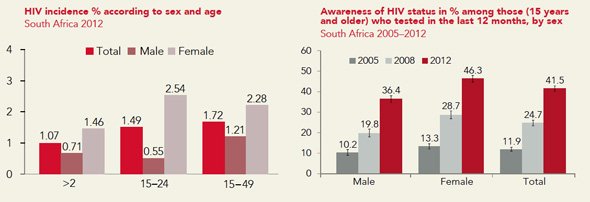
The most alarming finding of the survey is that young women between the ages of 15 and 24 had the highest incidence of HIV infection of all age categories. They made up one quarter (113 000) of all new infections in that year. Young women are 2.5 times more likely than the general population, and 5 times more likely than their male peers, to become infected with HIV. This is due to what we call intergenerational and transactional sex. Older men, with a higher accumulated risk of HIV, are seeking out younger women, often in exchange for meeting their need for the basic necessities of life – cash, clothes and cellphones – or young women are coerced, sometimes violently so. In light of the economic downturn and high food price inflation, high youth unemployment and unacceptably high school dropout rates; young women are increasingly vulnerable to sexual demands made on them by older, employed men with money.
At SANAC we have identified this phenomenon as the single biggest prevention priority if we want to turn the tide against this epidemic of new infections. Targeting young women and older men in a way that unravels this dominant sexual pattern is the key to changing our epidemic dynamics and setting HIV incidence on a more impressive downward trend. Changing this pattern of sexual behaviour will prove to be extremely difficult as it has as much to do with structural factors such as poverty, gender inequality, circular migration, the breakdown of family structure and alcohol and substance abuse as it has to do with sexual behaviour change. We ignore this crisis at our peril!
KEY FACTS:
HSRC National HIV Prevalence, Incidence and Behaviour Survey, 2012
The study was conducted between January and November 2012. 38 431 people across South Africa were interviewed. 28 997 agreed to be tested for HIV.
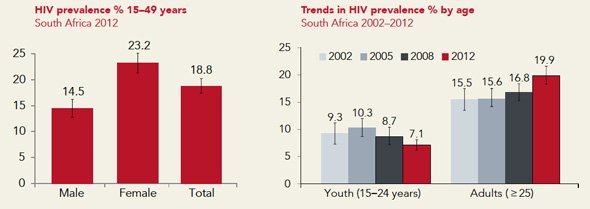
6.4 million people living with HIV = 12.2% of the total population
| Young women between 15 and 24 have the highest incidence of HIV infection of all age categories and accounted for a quarter of all new infections in 2012. | The HSRC used a new technology – HIV incidence testing – to measure the number of new infections in the country. |
*This article was first published in the Sunday Independent