


South Africa’s Revitalised Response To HIV and AIDS
On October 23 the South African government took the fight against HIV and AIDS to parliament, where deputy president Kgalema Motlanthe and health minister Dr Aaron Motsoaledi revealed the HIV Counselling and Testing (HCT) campaign to parliamentarians and parliamentary staff.
Citing the latest Global HIV Progress Report from the United Nations Programme on HIV/AIDS (UNAIDS), Motlanthe said that 70 percent of all new HIV infections last year were in sub-Saharan Africa. “Of most concern,” he said, “the UNAIDS report shows that 88% of new infections in children under the age of 15 occurred in sub-Saharan Africa.”
This shows how enormous the HIV challenge still is. In South Africa alone there were 370,000 new HIV infections in 2012.
But a valuable lesson that this country has learned is that political leadership is a key ingredient in tackling the epidemic. Most notably, in April 2010, the president and his Health Minister Dr Aaron Motsoaledi launched what is today regarded as the most extensive campaign to encourage citizens of any one country in the world to test for HIV. The two took the HIV test themselves and spoke openly about testing and its importance. By the end of the campaign 10.7 million people had been tested. This was a rare phenomenon. Never before had so many people considered HIV testing. Before 2009, the number of people tested had never exceeded 2.6 million in one year. Over the 20 months following the HCT campaign launch, 20 million South Africans tested for HIV. The hike in the number of people getting tested in recent years is directly attributed to the national HCT campaign. Such is the power of political leadership!
At a SANAC meeting in April, Minister Motsoaledi announced plans to re-launch the HCT campaign. He said there was a need to move away from sporadic testing campaigns to a more sustained programme. “Testing is an entry point to HIV prevention, care and support. All people receiving counselling and testing get access to condoms. It is also a tool for social mobilisation on HIV and AIDS and TB. It further contributes to the reduction of stigma,” he said.
Dr Motsoaledi added that he would like the campaign to be supported at all levels of society: “Members of Parliament need to support this campaign. Society must see that their leaders are serious about this. After that it must go to all provincial legislatures and then to districts, municipalities and ward councillors. I also want it to be launched in churches.”
The launch of the parliamentary HCT campaign was a precursor to the unveiling of a renewed national social mobilisation campaign to encourage South Africans to test for HIV on World AIDS Day 1 December 2013.
In addition to the HCT revitalisation campaign, World AIDS Day 2013 would mark the launch of a new drive to rally South Africans around medical male circumcision. Studies conducted in South Africa and elsewhere have shown that medical male circumcision – the full removal of the foreskin – can protect men from contracting HIV by up to 60% if condoms are used correctly and consistently when having sex. Evidence shows that the inner layer of the foreskin is more likely to absorb the HI virus than any other skin, as it is more prone to small tears during sex and has cells that attract the virus. Circumcision can also reduce the transference of the herpes type 2 virus, reduce the chances of cervical cancer in women, and keep the penis clean and free of odour.
In addition to saving lives, there is also a monetary saving. South Africa could reduce the money it spends on buying anti-retroviral treatment as less people will need ARVs. South Africa spent just over R3 billion on ARV treatment in the last two years.
The Global Fund to fight AIDS, TB and malaria recently approved a R3 billion grant for South Africa which will fund services for high risk and neglected communities such as sex workers and men who have sex with men. Innovative interventions include providing AIDS and TB screening and testing services in South African prisons. South Africa’s inmate population has a very high TB prevalence, with the probability of contracting TB is 90% for prison stays of six months and longer.
In 2010, several policies were implemented:
- All children under one year of age must receive treatment if they test positive.
- All patients with both tuberculosis (TB) and HIV will receive anti-retroviral treatment if their CD4 count is 350 or less.
- All pregnant HIV-positive women with a CD4 count of 350 or with AIDS symptoms, regardless of CD4 count, will have access to treatment. All other pregnant women not falling into this category, but who are HIV-positive, will be put on treatment at 14 weeks of pregnancy to protect the baby. In the past, this was only started during the last term of pregnancy.
- Anti-retroviral treatment will be accessed at primary health care or clinic level.
On 12 August 2011, deputy president Kgalema Motlanthe, in his capacity as the chairperson of the South African National AIDS Council, announce that people living with HIV with CD4 cell counts of 350 or less would be eligible to access ARVs with immediate effect.
On 1 April 2013, Health Minister Dr Aaron Motsoaledi, launched a progressive form of anti-AIDS treatment called a fixed dose combination (FDC). This meant that patients would no longer struggle with taking multiple pills at various intervals during the day. They can now take all three drugs they need for optimal treatment of HIV infection in one pill.
You are once again being called upon to take responsibility for your own life and to encourage others to take responsibility for theirs.
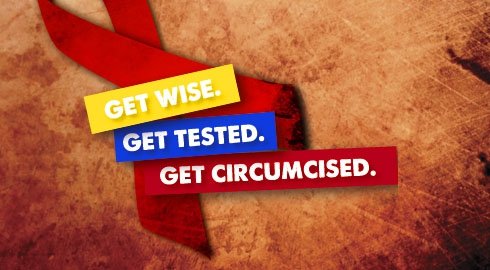
Get wise. Get tested. Get circumcised.